

The Plumbing Leaks That Hide Until They're Expensive
by Phillip McClain | Aug 6, 2025 | Home Inspection Notes
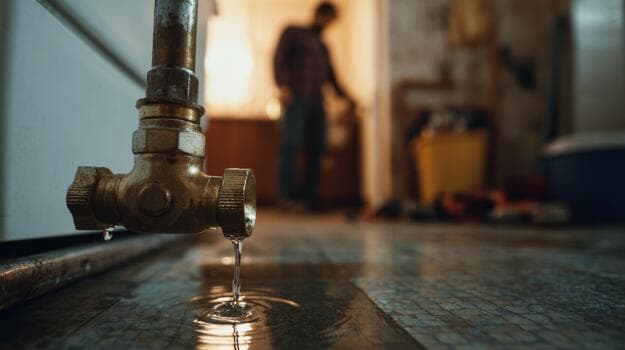
I've been under more vanity cabinets than I can count. There's almost always something interesting under there. Sometimes it's just an old can of polish from 2008. Sometimes it's a slow leak that's been working on the cabinet floor for two years and the homeowner had no idea.
The dramatic plumbing failures get attention. A pipe bursts, you turn off the water, you call a plumber, you mop. The slow leaks are the ones that destroy homes in Florida. Ten dollars a month of water bill, fifteen thousand dollars of damage by the time anyone notices.
Here's where I find them.
Under sink cabinets
The most common spot I find an active slow leak. Look at the bottom of the cabinet. Discoloration, swelling, soft spots, white or rust-colored mineral residue, mold blooms in the corners. Run the faucet and look at the trap and supply lines while it's running. Sometimes you'll see a single drop forming at a fitting every five seconds.
A drop of water every five seconds is about a gallon a day. Not a lot. Eight gallons a week, into a cabinet floor that doesn't dry out. That's how cabinets rot.
The fix on most of these is a $4 trap kit and a wrench. The damage if you ignore it is the cabinet, the wall behind it, sometimes the subfloor.
Slab leaks
This is a bigger issue in central Florida than people realize because most homes here are built on slab. The plumbing supply lines that run under the slab can develop pinhole leaks over time, especially copper that's been in there since the 70s or 80s. The water then has nowhere to go but up through the slab, into your flooring, and around the perimeter.
Signs of a slab leak: an unexplained warm spot on the floor (it's almost always the hot water side), tile that's starting to bow or crack in a localized area, a baseboard that's getting damp without an obvious source, the water heater running more than normal, an unexplained spike on the water bill.
I check water meters at every inspection. With everything off in the house, the meter dial should be still. If it's slowly turning, there's a leak somewhere. If the homeowner can't account for it, it's worth investigating.
Slab leaks are repairable but it's a project. Sometimes they're rerouted overhead through the attic to avoid jackhammering. The repair runs anywhere from $1,500 to $5,000 depending on what's involved. The damage if you don't fix it gets worse fast.
Toilet wax rings
Wax rings under toilets fail when they get tired or when the toilet has shifted slightly over time. The leak is usually small, intermittent, and goes straight down through the floor instead of out where you can see it. The first sign you have is a soft spot in the flooring around the base, or sometimes a stain on the ceiling below if you have a second floor.
I rock every toilet during an inspection. A toilet that moves at all is on a wax ring that's likely failing. I also look for caulking around the base of the toilet that's discolored or missing in spots. Some plumbers caulk the front and sides only, leaving the back open so leaks become visible. That's actually a good practice.
If the floor around your toilet is soft, your subfloor is likely already wet. Don't ignore it.
Water heater drip pans
Code requires water heaters to be in a drip pan with a drain that goes somewhere harmless. Most older homes have either no pan, or a pan that's not draining anywhere, or a pan that's already rusted through. Every water heater eventually leaks. The pan and drain are the difference between a maintenance event and a flooded room.
I check the pan condition, look for rust or corrosion at the base of the tank, and check the temperature pressure relief valve and discharge tube. If that valve discharges and the tube doesn't go to a safe location, hot water sprays where it shouldn't.
A water heater that's 12 years old in this region is past its expected life. Add the humidity factor and they don't last as long here as the manufacturer rates them for.
Supply line corrosion
The flexible supply lines that connect to your toilets, sinks, and washing machine. The braided stainless steel ones are good. The old plastic ones with brass fittings are not. They fail. When they fail, they let go all at once at full water pressure.
I push on every one I can reach to check for stiffness. New lines are flexible. Old lines are stiff and crack at the fittings. Replacement supply lines are $15 each. A washing machine supply line that lets go on a Tuesday morning while you're at work is the kind of damage that totals first floors.
Less obvious places to check
The dishwasher. Pull the kick plate at the bottom and look. Slow leaks here pool under the dishwasher and damage the cabinets next to it.
The refrigerator water line. The plastic ones tend to fail. Behind the fridge is also where I find rust on the floor that the homeowner has never seen.
Around the washing machine. The drain hose connection, the supply lines, the area under and behind the unit. Laundry rooms are the second most common flood location in homes I see, after kitchens.
The shut-off valves throughout the house. Old ones seize up and leak when finally turned. New ones are quarter-turn and quick. If you've never been able to find or use the shut-offs in your house, that's worth solving on a Saturday before there's an emergency.
What to do if you suspect a leak you can't find
Turn off everything in the house, watch the water meter for ten minutes. If it's moving, you've got a leak. If you can't locate it visually, get a leak detection service in. They use acoustic listening equipment and can pinpoint where to dig.
Don't ignore it because you can't find it. Florida humidity plus a hidden leak is exactly how mold colonies start.
Plumbing leaks are the kind of issue where small money fixed early is way better than big money fixed late. That's most of the inspector's job, really. Showing you what's small and easy to fix today, before it isn't either.