

Energy Upgrades Worth Doing in a Florida House
by Phillip McClain | Sep 9, 2025 | Home Inspection Notes
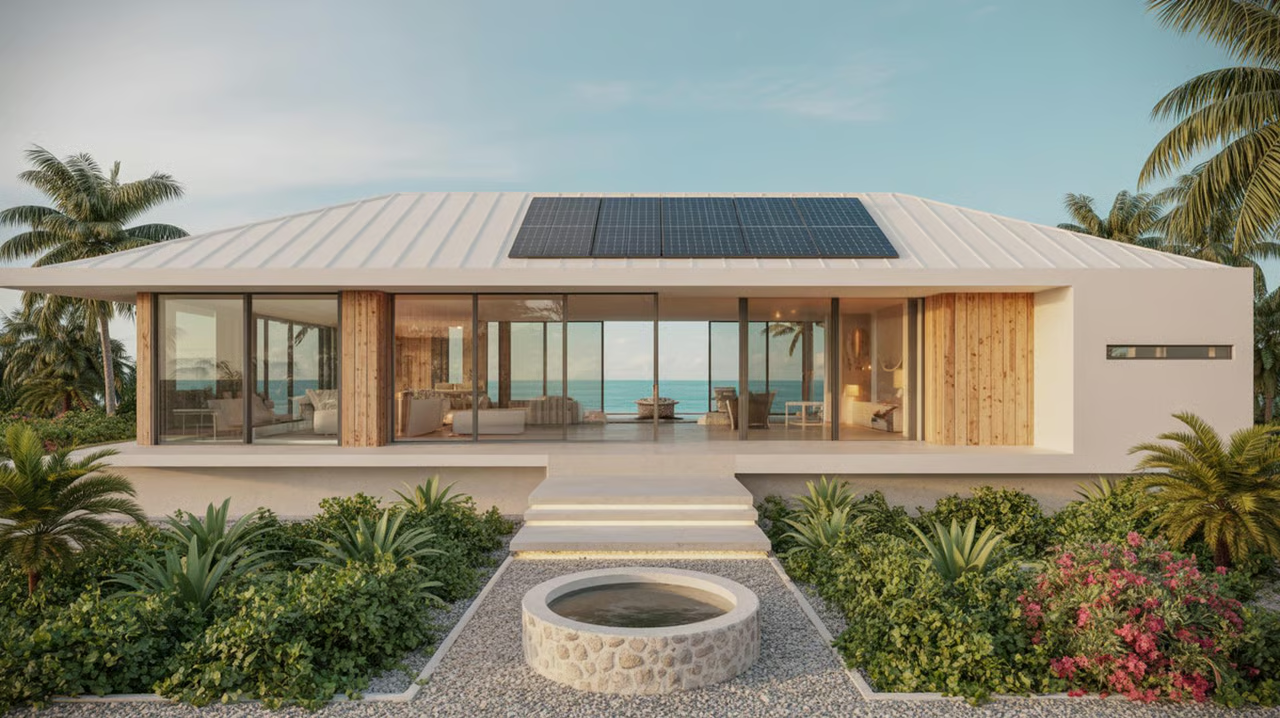
The home improvement world is full of upgrades that promise huge savings and don't deliver. Some of them are a flat-out bad idea in Florida. Some of them are great in the abstract and bad for your particular house. And some of them are quietly the best money you'll spend on your house, even if they don't make for great Pinterest photos.
I've inspected homes where the owners put $30,000 into solar before fixing $2,000 of attic insulation issues. I've inspected homes where someone sealed every air leak around windows for the cost of a few tubes of caulk and a Saturday and dropped their power bill 20%.
Here's how I'd think about it for a typical central Florida home.
Attic insulation, every time
This is the one. If you do nothing else, do this. Florida code recommends R-30 in the attic for our climate, and a lot of older homes have R-19 or even R-13 from when they were built. You walk into the attic and the rafters are visible because the insulation is so thin.
Adding blown-in insulation to bring an attic up to R-38 runs $1,200 to $2,500 depending on the size of the home and how much is already there. That's it. The savings on summer cooling are immediate and noticeable. I've had clients tell me they noticed it the first week.
What I'd add to this: a radiant barrier, either as a foil decking material on a re-roof or as a foil sheet stapled to the underside of the rafters. The decking version is more effective, but you only get to do it during a roof replacement. The retrofit foil works too, just slightly less efficient.
In a Florida summer the attic temperature can get to 140 to 160 degrees. Anything you do to keep that heat out of your conditioned space is worth doing.
Sealing the envelope
The unsexy one. Caulking around windows, weather stripping at doors, foam sealing penetrations where pipes and wires come into the house, sealing the connections between ductwork and registers.
This stuff costs almost nothing in materials and can be done in a weekend. It works because it directly reduces how much air gets exchanged between conditioned and unconditioned spaces. You're not adding insulation, you're just stopping leaks.
I run a thermal camera on inspections sometimes and you can immediately see where the air is moving in. Door bottoms with worn weather stripping are common. Recessed light fixtures in attics that aren't sealed. Penetrations under sinks where the plumber drilled an oversized hole. All easy to fix.
A modern thermostat
Smart thermostats are mostly worth it in Florida because cooling load is so steady. The schedule logic that helps in northern climates (warm during the day, cool at night) doesn't apply much here, but the geofencing and remote-control features do. Coming back from a weekend trip and being able to start cooling the house from your phone is a real benefit.
Programmable behavior matters too. Most homes I inspect have the thermostat set to a single temperature 24/7 and the AC just runs whatever it takes. Adjusting up 3 to 4 degrees during work hours, when the house is empty, saves real money and the homeowner never feels it.
A Nest or Ecobee runs $200 to $300 installed. Pays back in a season or two on most homes.
Heat pump water heater (situational)
Worth mentioning because the federal tax credits make these much more attractive than they used to be. A heat pump water heater pulls heat from the air around it (usually a garage) to heat your water. Way more efficient than a conventional electric water heater.
The catch is they need a relatively warm space to operate efficiently, and they cool the room they're in. In a Florida garage that's mostly fine. In a closet inside the house, it can cause problems.
If you're already replacing a water heater, this is worth pricing out. The unit is more expensive but the rebates and the efficiency gain make the math work for many homes. If your existing water heater is fine, don't replace it just to chase efficiency.
Solar (it depends)
Solar in Florida is very situational and the math has changed a lot in recent years. The general principle is sound. We have lots of sun. Solar production is high. The catch is that net metering rules in Florida have changed, the price of electricity from utilities is still relatively reasonable, and the upfront cost is substantial.
I've seen homeowners do well on solar and I've seen homeowners regret it. Some general rules:
A south-facing roof in good condition with no shading is the requirement. North-facing or heavily shaded systems don't produce enough.
Don't put solar on a roof that's more than 7 or 8 years old without doing the roof first. Removing and reinstalling panels for a roof job in year 12 is a big extra cost.
Get multiple quotes. Some installers in this market are aggressive and oversell systems.
Read your net metering terms. Florida's are changing.
If you're in a HOA, check restrictions. Florida law generally protects solar, but specific implementations vary.
What I wouldn't bother with
Replacing functional double-pane windows just for energy. The savings versus payback math almost never works. If the windows are old single-pane or the seals have failed, that's different.
ENERGY STAR appliances when your existing ones work fine. Newer is more efficient, but the savings rarely justify discarding a working appliance.
Whole-house dehumidifiers as standalone units. Most modern AC systems handle dehumidification adequately on their own if they're sized right and maintained.
Tankless water heaters in homes with high simultaneous-demand usage. They're great in single-occupant houses, less great in family homes that run multiple showers and the dishwasher at the same time.
Where the inspection comes in
If you're considering improvements, an energy-focused walkthrough can help you prioritize. I'm not selling solar or attic insulation. I'm just looking at where the actual losses are, which is the right starting point before you commit to any specific improvement.
A roof close to its end of life and an attic with R-13 insulation in central Florida are the two highest-return targets in most older homes. Fix those, and the rest matters less than the marketing makes it sound.